




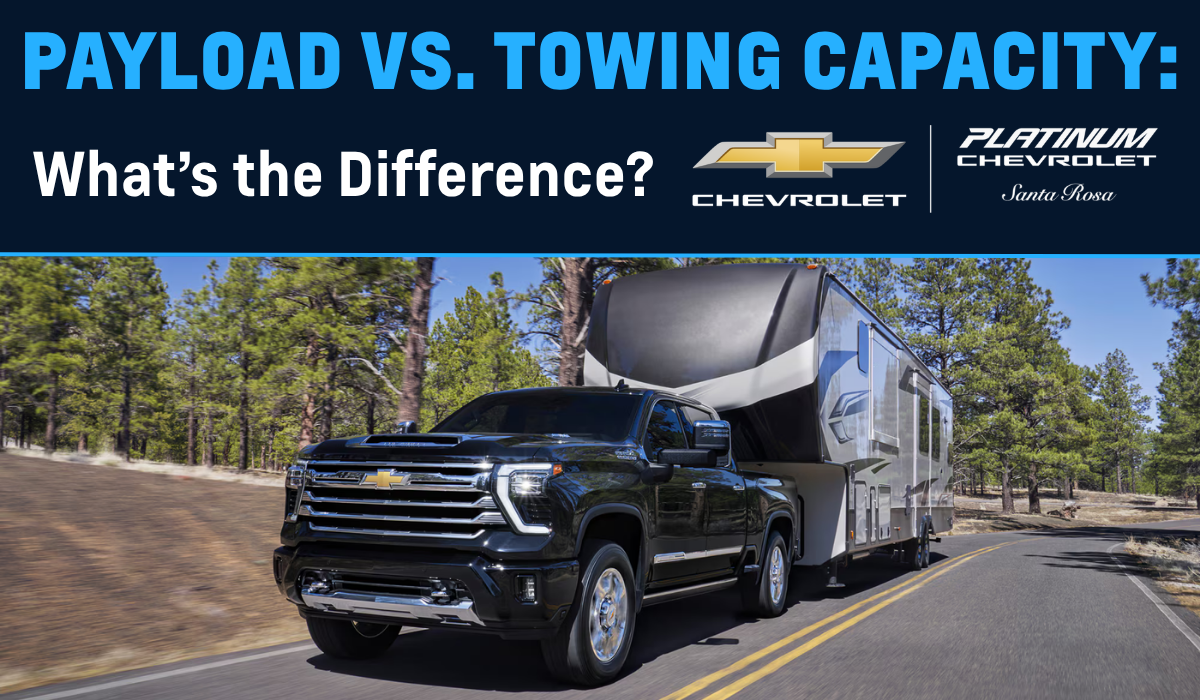
Payload vs. Towing Capacity: What’s the Difference?
Payload vs. towing capacity comes down to what your truck can carry and what it can pull, but passengers, tools and a connected trailer all affect how those limits work together. Whether you’re hauling equipment around Santa Rosa or packing for a Sonoma Coast camping trip, understanding both numbers helps you choose a Chevy truck that fits the entire load.Explore Chevrolet Truck Inventory
Payload Capacity vs. Towing Capacity: The Key Difference
Payload capacity limits the added weight your truck can carry. Towing capacity limits the loaded trailer weight it is rated to pull under specified conditions. Both matter whenever you connect a trailer.| Rating | What it covers | Everyday example |
|---|---|---|
| Payload capacity | Occupants, cargo, added equipment and trailer weight supported by the truck | Your family, camping supplies, hitch equipment and trailer tongue weight |
| Towing capacity | The trailer and everything loaded into or onto it | A utility trailer carrying landscaping equipment |
These limits overlap because part of a connected trailer’s weight rests on the truck through the hitch. That downward force uses available payload.
A trailer can therefore fall below the truck’s towing limit while the truck exceeds its carrying limit. Checking only the advertised towing capacity leaves part of the calculation unfinished.
What Is Payload Capacity?
Payload capacity is the maximum added weight a vehicle can carry, including passengers, cargo, added accessories and trailer tongue weight. It is generally calculated by subtracting the truck’s curb weight from its Gross Vehicle Weight Rating, or GVWR.Payload includes much more than what fits in the truck bed. Account for:
- The driver and every passenger.
- Tools, luggage, coolers and other cargo in the cab or bed.
- Added accessories, such as a toolbox or camper shell, not already reflected in the labeled capacity.
- Added hitch equipment.
- Trailer tongue weight, including gooseneck hitch load, or kingpin weight for a fifth-wheel trailer.
Count each item once. Factory-installed equipment already reflected in the vehicle-specific rating should not be subtracted again.
A full standard fuel tank is included in curb weight, so that fuel should not be deducted twice either. Extra fuel carried in containers and added auxiliary equipment still need to be counted.
How Does Trailer Tongue Weight Affect Payload?
Tongue weight is the downward force a trailer places on the hitch, and it counts toward the truck’s payload. This is the connection many shoppers miss when comparing towing ratings.The Chevrolet Trailering Guide generally recommends tongue weight of 10% to 15% of loaded trailer weight for conventional trailers. Certain trailer types, including some boat trailers, have different requirements, so follow the trailer manufacturer’s instructions and the vehicle’s limits.
For example, a 7,000-pound loaded travel trailer with 13% tongue weight places 910 pounds on the hitch. That leaves less capacity for passengers, cargo and added equipment.
Use the trailer’s ready-to-travel weight when planning. Water, propane, batteries and camping supplies can make a meaningful difference from its advertised dry weight. A percentage provides a planning estimate; measuring the actual tongue weight tells you what the truck is supporting.
A Payload vs. Towing Capacity Example
Imagine a truck with a 10,000-pound trailer weight rating and 1,800 pounds of available payload before loading. These are hypothetical figures, not specifications for a particular Silverado.You plan to tow the 7,000-pound travel trailer described above:
| Load added to the truck | Weight |
|---|---|
| Driver and passengers | 650 lbs. |
| Luggage, cooler and other cargo | 200 lbs. |
| Added hitch equipment | 100 lbs. |
| Added accessories not included in the labeled capacity | 100 lbs. |
| Trailer tongue weight | 910 lbs. |
| Total payload used | 1,960 lbs. |
The trailer is 3,000 pounds below the stated tow rating, but the truck’s payload is 160 pounds over its limit.
Before connecting the trailer, passengers, cargo and equipment have already used 1,050 pounds. That leaves 750 pounds for tongue weight, less than the 910 pounds in this example.
The load or vehicle combination needs to change before the trip. Removing unnecessary cargo may help, or you may need a lighter trailer or a truck with more capacity. Do not shift trailer cargo rearward simply to reduce tongue weight below the manufacturer’s recommended range.
Passing the payload calculation is only one check. The truck, trailer, axles, tires and hitch must also remain within their applicable limits.
Where to Find Your Chevy Truck’s Actual Ratings
Start with the specific truck, not the largest number in an advertisement. Engine, cab style, bed length, drivetrain and trailering equipment can all affect capability. Two Silverados with similar appearances may have different ratings.Check the labels around the driver’s door opening and the appropriate owner’s manual. The Tire and Loading Information label identifies the occupant-and-cargo limit. Where fitted, Chevrolet’s Trailering Information Label provides additional vehicle-specific towing information.
| Rating | What it means |
|---|---|
| GVWR: Gross Vehicle Weight Rating | The maximum total loaded weight of the truck, including the truck itself |
| GCWR: Gross Combination Weight Rating | The maximum weight of the complete loaded truck-and-trailer combination |
| GAWR: Gross Axle Weight Rating | The maximum weight supported by an individual axle |
Curb weight is the truck’s weight with its equipment and operating fluids, before occupants and cargo. It is a starting measurement, not another maximum rating.
When checking combined weight, count tongue weight once. It remains part of the trailer’s total weight, even though the hitch transfers that load onto the truck. Scale measurements help you check actual axle loads with the towing equipment properly configured.
Our Chevrolet Truck Towing Capacity Guide provides additional model context. Match any published figure to its stated model year and configuration.
Common Towing and Payload Mistakes to Avoid
A few assumptions can make a suitable-looking truck and trailer combination exceed its limits:- Shopping by the advertised maximum. That number may require a different engine, cab, drivetrain or trailering package from the truck you are considering.
- Using the trailer’s dry weight. Plan around its loaded weight, including supplies, water and equipment.
- Overlooking equipment that stays in the truck. Toolboxes, bed covers and added hitch hardware can use capacity before passengers climb in.
- Treating a weight-distributing hitch as extra capacity. It redistributes load when used correctly; it does not increase the truck’s GVWR, axle ratings or towing limits.
Follow Chevrolet’s instructions for the hitch type and equipment required for your combination.
Planning for Work and Weekend Loads in Sonoma County
A truck carrying tools to a job in Santa Rosa faces a different load from the same truck leaving for the coast with a camper and passengers. Calculate each setup separately.Include items that stay in the vehicle between trips, such as recovery gear, toolboxes and child seats. For work use, count the crew and equipment traveling in the truck as well as the equipment on the trailer.
Before departure:
- Load for the actual trip. Account for occupants, supplies and trailer contents.
- Weigh the combination. Use a suitable vehicle scale to check truck and trailer axle loads against their ratings.
- Check the equipment. Inspect tires, lights, brakes, hitch connections and safety chains according to the applicable manuals.
Choosing Between a Silverado 1500 and Silverado HD
Bring your loaded trailer weight, measured tongue or kingpin weight, passenger estimate and cargo list into the comparison. Those details make the decision more useful than starting with a maximum towing claim.Your shortlist might include a Silverado 1500, 2500 HD or 3500 HD. The right match depends on the ratings of the individual truck and the equipment your trailer requires. A higher trim level does not automatically provide more payload.
At Platinum Chevrolet in Santa Rosa, we can help you review Chevrolet’s published trailering information and compare available trucks. Bring your trailer information and photos of your current truck’s weight labels so we can work through the details together.
Contact Our Team About Your Towing Needs